
Transforming Transactional Practice: How AI Is Reshaping Negotiation and Due Diligence

Updated: Feb 2
Transactional Practice is at a turning point.
AI has moved decisively from a nice-to-have to a core capability, fueled by record technology investment and rapid innovation across the legal market. Tasks that once took weeks can now be done in hours, making AI-enabled workflows across negotiation and due diligence the new standard for organizations seeking greater efficiency, risk reduction, and sustainable competitive advantage.
Yet technology alone is not the differentiator. The real challenge lies in disciplined execution: integrating AI into existing workflows while balancing speed, accuracy, and trust to meet rising client expectations.
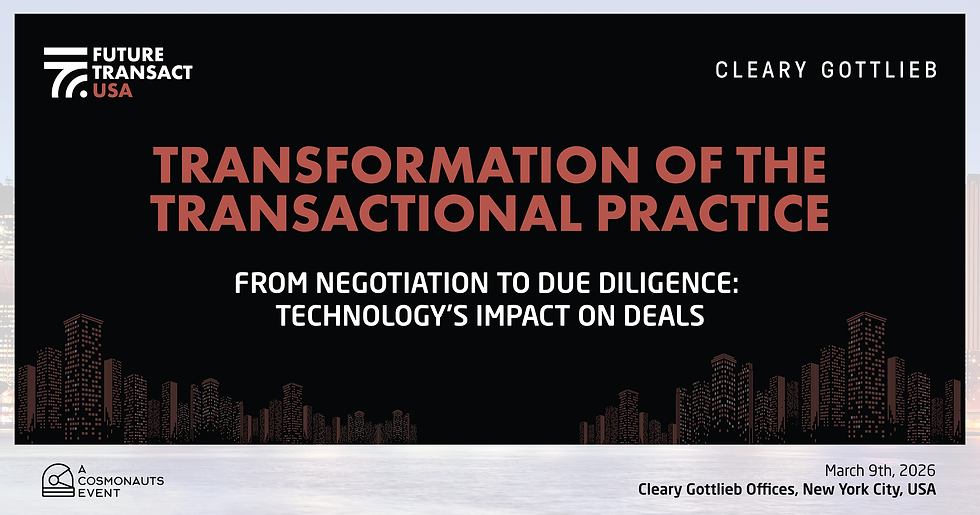
Against this backdrop, Future Transact USA presents the panel “Transformation of the Transactional Practice: From Negotiation to Due Diligence: Technology’s Impact on Deals,” bringing together practitioners and leaders shaping how deals are done today and tomorrow.
From Manual Review to AI-Enabled Workflows

AI is transforming how transactional work gets done as deal structures grow more complex. Katherine Forrest, Partner at Paul, Weiss, notes that AI workflows mirror the logical, step-by-step sequences of traditionally manual processes, translating them into scalable, automated systems.
James Ding, CEO and Co-Founder of Draftwise, explains how Draftwise’s AI distills decades of transaction data into actionable insights, validates contracts against term sheets, and recommends clauses based on prior deals. Will Seaton, Chief Customer Officer, adds that this knowledge is now embedded directly within lawyers’ drafting environments.
Due diligence highlights similar gains. Rick Van Esch, CEO and Co-Founder of Emma Legal, described the process as “still slow, expensive, and heavily manual,” adding that “we knew there had to be a better way.” Traditional approaches often struggle to manage vast volumes of financial and contractual data. By applying large language models to complex datasets, Emma Legal’s AI accelerates risk assessment and shortens deal timelines without compromising oversight.
Efficiency vs. Accuracy: The Trust Question

Efficiency is often the first promise of legal tech and innovation, but in high-stakes legal work, accuracy and defensibility are what ultimately determine trust. Legal professionals need confidence that outputs are accurate, explainable, and defensible. As the saying goes, “Speed without trust creates risk. Trust without efficiency creates frustration.”
The risks of ungoverned AI are no longer theoretical. Recent AI-related sanctions, from fabricated cases in New York 2023 to citation errors in Virginia 2024, underscore the risks of ungoverned systems. Human oversight, explainability, and well-designed workflows remain non-negotiable.
Technology, therefore, is not just a product choice but a governance decision. Data security and confidentiality are legal imperatives. Freeths’ collaboration with Legora reflects this approach, with responsible AI and client data protection as foundational requirements.
Adoption & Scaling: Why Change Is Hard

The biggest barrier to transformation is rarely the technology itself; it is change management. A BCG survey echoes this reality: while transformation may be led from the top, success depends on adoption by the people in daily practice. Different practice groups operate under distinct workflows, making one-size-fits-all rollouts ineffective.
Successful transformation requires training, partner buy-in, and integration with existing systems. True transformation does not come from deploying standalone solutions but from deliberate rollout strategies that reflect organizational structure, practice-level realities, and long-term change management. Mid-sized organizations may prioritize tools like August that reflect local legal realities rather than generic global platforms, while more mature organizations are designing bespoke AI workflows. Paul, Weiss’s investment in Harvey’s Workflow Builder and Freeths’ deep integration of Legora illustrate how firms are embedding AI directly into core operations.
Adoption is ultimately a people and culture challenge. Without trust, incentives, and alignment with how legal professionals actually work, even the most advanced AI will remain underused. Carla Swansburg, CEO of ClearyX, a featured panelist at our March discussion, once argued that meaningful change requires new operating models and dedicated teams so innovation can move fast without being constrained by legacy structures. As Raghu Ramanathan, President of Legal Professionals at Thomson Reuters, observes, “The question isn’t whether traditional operating models can survive, but whether law firms are committed to truly transform.”
Client Expectations as the Real Catalyst

Clients are no longer willing to accept slow delivery, opaque pricing, or inefficiencies masked by tradition. While hourly billing persists, clients increasingly resist rising rates that capture productivity gains on the organization’s side alone. Accustomed to speed and transparency elsewhere, they now expect the same from legal providers.
This shift in client expectations is reshaping the legal sector faster than internal reform ever could. AI alone is not the differentiator. Client-centricity is. Organizations that pair technology adoption with transparency, pricing reform, and a clear articulation of value will earn trust and remain relevant.
As Rutvik Rau, CEO of August, notes, “Midsize firms are actually extremely innovative, because they're trying to provide the best client services. Their clients are extremely cost-sensitive, and that creates the right environment to use AI and really reap the benefits.”
Clear your calendar for March 9th. Beyond a deep dive into the deal landscape, you’ll gain practical, hype-free insights from the experts shaping the industry today.


Comments